

Where the Darkness Fell—Phillip Yancey's Betrayal
Can anything good come out of the patriarchy?
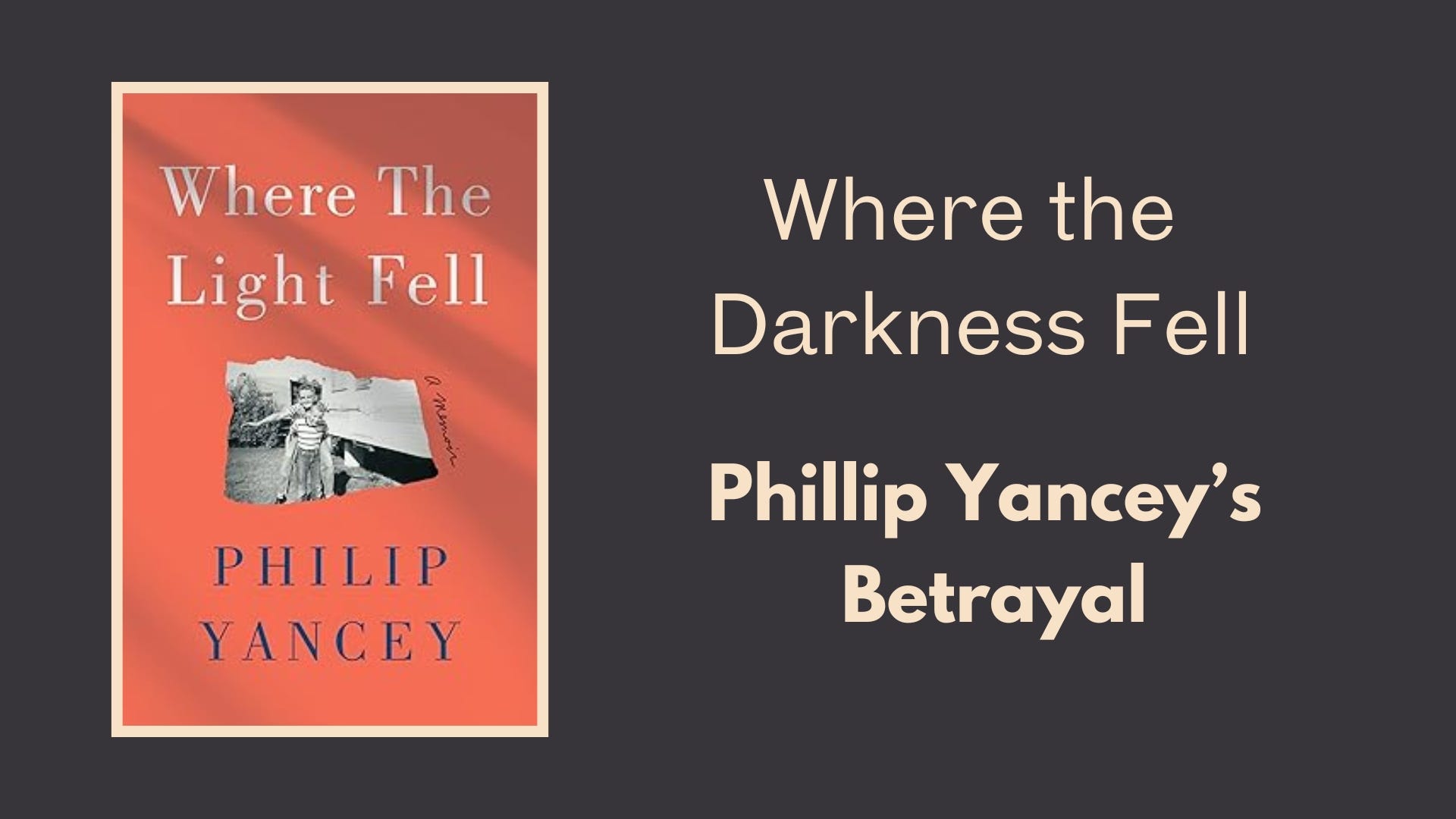
I’m an optimist, but it’s getting hard to find good news these days. And it’s even messier if you’re a believer, but not a MAGA Christian. It seems that lies and abuse have become commonplace throughout the world, and especially among those who call themselves Christians—people who are supposed to be the bearers of “good news,” are often bearers of abuse. That’s why it’s so disappointing to hear that Philip Yancey has had an eight-year affair behind his wife’s back.
During my “church-going, convert-everybody years,” I was a big fan of Philip Yancey. I liked his books, especially The Jesus I Never Knew and What’s So Amazing About Grace? He offered a refreshing take on how Jesus treats people—much better than we humans do.
As a writer of memoir myself, I especially enjoyed Where the Light Fell, a memoir recounting times when things looked dark, but something bright came through to remind him of God’s grace.
Sadly, when a man teaches grace and then abuses it so freely for himself, it renders the idea of grace useless. My fundy father would call it “Cheap grace.” (And if you’ve read my memoirs, he seemed to know about taking the grace of God for granted.)
As an animal lover, one of the stories in Yancey’s memoir made me cringe. When he was a boy, he and a friend dumped boulders on top of turtles, leaving them to die with broken shells. He said he felt ashamed of that for years.
Today, when I read about his affair, I thought of all the fragile believers who have learned about God’s grace from his books and have now discovered that he didn’t live what he preached. With his announcement and departure from public ministry, it feels like he is smashing the fragile faith of those who still believe. I even wonder how Jesus can forgive such flagrant abuse of God’s grace.
There’s a lot to unpack in Yancey’s final statement. Of course, he was a hypocrite, and it’s very disappointing. The skeptic in me wants to engage in evil surmising. Did he only confess because he got caught? Or did the affair end due to his impending Parkinson’s disease? And what gave him the nerve to write such a memoir while he was cheating on his wife? I have a pile of stones that I want to throw at him.
But what is most disturbing to me is the statement from his wife.
“I, Janet Yancey, am speaking from a place of trauma and devastation that only people who have lived through betrayal can understand. Yet I made a sacred and binding marriage vow 55½ years ago, and I will not break that promise. I accept and understand that God through Jesus has paid for and forgiven the sins of the world, including Philip’s. God grant me the grace to forgive also, despite my unfathomable trauma. Please pray for us.”
I remember when Bill Clinton finally stopped lying and admitted what he did to Monica Lewinsky. I was angry—not so much at him, because I had already come to expect that men can be pigs. No, I was angry that Hillary didn’t leave him. In my young mind, it was a binary situation, and divorce was the only solution.
Of course, looking back, I realize Hillary was playing her cards. She not only had a daughter with him, but they were a political power couple, and they had a lot in common. Most people looking at her today realize that Hillary is her own person, and while she did show grace to Bill, she didn’t bow down to him in any way.
But a few weeks or months of an affair is much different than an eight-year affair. I’m not excusing anyone having an affair, but I do believe there is room for grace—with one caveat—there needs to be respect.
If someone messes up, they must find a way to restore the respect they trampled on. And even more important, the person cheated on has to have respect for herself. Many of us suspect there were other times Bill cheated on Hillary, but Hillary has respect for herself, and that is vital to her sanity.
This isn’t really about the Clintons or even the Yanceys, but about the fact that we expect our leaders to walk the talk—whether they are in the church or the political arena. And part of the curse of patriarchy is that women are not allowed self-respect, because respecting their husbands is often required before they are allowed to care for themselves.
I am most disturbed by Janet Yancey’s words.
“I made a sacred and binding marriage vow 55½ years ago, and I will not break that promise.”
These words are not about grace or love, but obligation. Her statement alone tells me all I need to know about the Yanceys’ picture of God. It also tells me all I need to know about the Yanceys’ marriage.
This was not a covenant marriage, which is a container for love and grace. It follows an arbitrary rule that traps many women in abusive marriages—the claim that you cannot undo the marriage even if the other has ripped the covenant to shreds.
A true marriage is a meeting of minds between equals. And if one of them breaks that agreement—even in secret—then the tie has been broken, and no one is obligated to stay. Yes, they can choose to stay, but obligation, such as what is written in Janet Yancey’s statement, will never be able to provide grace—especially in the face of caregiving with a Parkinson’s diagnosis.
This statement does not reflect grace or love. Yes, I am sure she loves him. This is clear by her devastation. But in the long term, only an empowered self can give love and grace after such a damaging betrayal. And most women with self-respect will say that they are free of any obligation to keep vows once he has broken the fragile ribbon that bound them on their wedding day.
I wish both of the Yanceys grace and peace. I hope that as Philip now has hours to sit with his life, he encounters a grace that requires honesty rather than image management. Grace that comes after repentance, not one that is used to excuse harm.
And I hope Janet comes to see that grace does not require captivity. She is not bound to become the caretaker of a man who betrayed her willingly and in secret for eight years. She has already paid more than her share of the cost.
Love is not an obligation. Grace is not endurance at all costs. And marriage vows are not a life sentence imposed on the faithful while the unfaithful walk free.
If there is any good news left in the world, it must include this truth—women are not required to sacrifice themselves in order for men to be forgiven.
https://www.christianitytoday.com/2026/01/author-philip-yancey-confesses-affair-withdraws-from-ministry
Excellent points, especially about the idea of obligation in the marriage vow. Eight long years? This is so heart breaking. Thanks for your thorough analysis. I'll read this over many times.
Sad story, yet some marriages can be mended, others cannot, because a line had been crossed. Mrs Yancey may blame herself somewhat. When that happens, I think people are more inclined to try to restore the marriage.
A book from the 90’s titled His Needs Her Needs makes some good points about married couples tending to each other’s needs, but I disagree somewhat about the division of needs by gender.